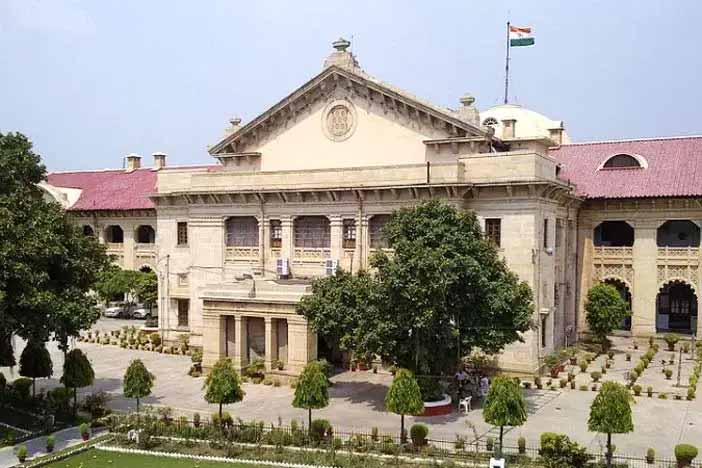
Allahabad High Court.
Allahabad High Court News: In a scathing indictment of law enforcement overreach and systemic apathy, the Allahabad High Court has ordered the Uttar Pradesh government to pay ₹2 lakh in compensation to a man illegally detained by the Prayagraj police for eight days.
The Division Bench, comprising Justice Siddharth and Justice Vinai Kumar Dwivedi, did not mince words, describing the ground reality within the Prayagraj Police Commissionerate as a “shocking state of affairs.” In a move aimed at establishing accountability, the court directed that the compensation amount—calculated at a rate of ₹25,000 per day of illegal confinement—be recovered directly from the salary of the Assistant Commissioner of Police (ACP), Bara, following a three-month disciplinary inquiry.
A Routine Arrest Turns Into a Courtroom Showdown

Justice Sidddharth, Allahabad High Court.
The case traces back to March 19, when local police picked up the petitioner, Mansoor Ahmad (also known as Lallu), in Patwari village. According to law enforcement, Ahmad had allegedly hurled abuses at locals, creating an imminent apprehension of a breach of peace. To prevent any cognizable offenses, the police invoked preventive action clauses and produced him before the ACP.
Under Section 170 of the Bharatiya Nagarik Suraksha Sanhita (BNSS), preventive custody is strictly capped. An individual cannot be held for more than 24 hours without explicit legal justification. Yet, Ahmad’s family watched the 24-hour mark pass, followed by days of silence, forcing them to approach the High Court for relief. Ahmad was finally released on March 27—eight days after his initial arrest.
The police justified the extended detention by claiming Ahmad failed to produce the required surety upon being presented to the ACP, leaving them with no choice but to remand him to judicial custody. However, when the High Court scrutinized the paperwork, the state’s narrative quickly unraveled.
READ: Freedom Over Bureaucracy: HC Sets ₹20K Bond Limit and Financial Penalties for Police and Magistrates
Justice by Rubber Stamp
The court discovered that the ACP had bypassed judicial due diligence entirely, ordering Ahmad’s detention using a pre-printed proforma. The boilerplate form was mechanically filled out, lacking any specific recital stating that Ahmad had actually refused to furnish a personal bond to maintain peace.
Instead of offering the petitioner a fair opportunity to secure his release, the ACP directly remanded Ahmad on March 19 and scheduled his next hearing for March 27.
The Bench pointed out that if Ahmad was unable to provide surety on day one, the administration was legally obligated to give him another chance the very next day to furnish a personal bond. By stretching the next calendar date out by over a week, the police effectively bypassed the statutory 24-hour detention limit. The court ruled that the provisions of Sections 170, 126, and 135 of the BNSS were “flagrantly violated” by the ACP, who was acting as the Special In-charge Magistrate.
A Deeply Rooted Systemic Malady

Justice Vinai Kumar Dwivedi, Allahabad High Court.
What elevates Mansoor Ahmad’s case from an isolated incident of police high-handedness to a systemic crisis is the data uncovered during the proceedings. Intrigued by the irregularities, the High Court requested detention statistics from the Chief Judicial Magistrate of Prayagraj. The findings were staggering.
The data revealed that Ahmad was merely one of thousands caught in a revolving door of unlawful detentions. In 2024, the registry recorded 283 individuals detained in violation of the law. That number skyrocketed to 1,321 in 2025, and has already reached 721 individuals for the current year of 2026.
The judges noted that the executive powers of a Magistrate, which were granted to the Commissioner of Police to streamline law and order, are instead “being misused to the hilt.”
Represented by Advocate Pushpendra Singh, the petitioners successfully argued that these bureaucratic shortcuts strip citizens of their fundamental liberty. Despite defenses mounted by Additional Advocate General Anoop Trivedi and Additional Government Advocate Mohd Shoeb Khan on behalf of the State, the court’s ruling serves as a stern reminder of constitutional boundaries.
The Uttar Pradesh government has been given six weeks to disburse the ₹2 lakh compensation to Ahmad. By ordering the state to claw back that money from the responsible officer’s pockets, the Allahabad High Court has signaled that the price of eroding civil liberties will no longer be footed solely by the taxpayer.
Don’t Miss: Strengthening the Shield of Democracy: Inside the ECI’s National Strategy to Face Emerging Legal Frontiers
Don’t Miss: Striking Off Tenant’s Defence Under Order XV Rule 5 CPC Not Automatic: Supreme Court