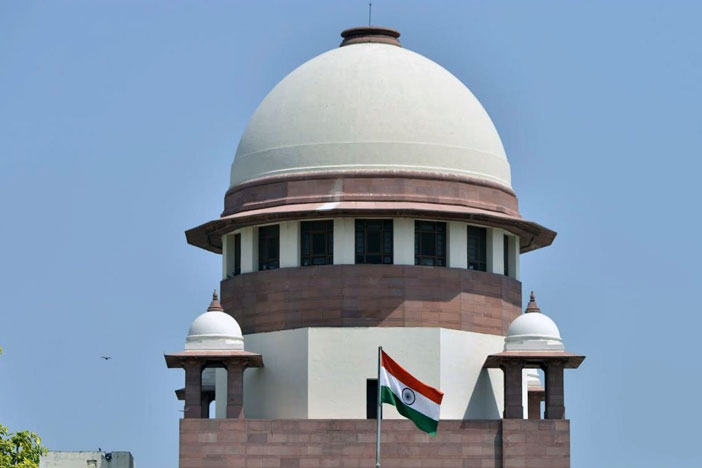
Supreme Court of India.
Supreme Court Draft Rules for Use of Artificial Intelligence (AI) in Legal Work: NEW DELHI — In what is being hailed as a watershed moment for the intersection of technology and jurisprudence, the Supreme Court of India’s AI Committee has released a comprehensive set of draft rules aimed at regulating Artificial Intelligence across the entire spectrum of the Indian legal system.
Titled the Draft Regulations for Use of Artificial Intelligence in Courts, 2026, the framework establishes a rigorous “human-in-the-loop” philosophy. While it proactively embraces automation to clear India’s notoriously backlogged dockets, it draws a stark, unyielding line between administrative assistance and the sacred, uniquely human act of adjudication.
The draft rules have been placed in the public domain, with stakeholders and legal professionals given until June 20 to submit their comments and suggestions. Once finalized, the regulations will apply uniformly across all judicial tiers: the Supreme Court, High Courts, district courts, tribunals, and statutory commissions.
The Doctrine of ‘Human Primacy’
At the absolute core of the 2026 draft regulations is the principle of “human primacy.” The framework explicitly dictates that AI must function strictly in an assistive capacity and cannot supplant, compromise, or dilute the independent exercise of judicial authority by an appointed officer.
The Supreme Court has made it clear that technology can handle the bureaucratic and analytical heavy lifting, but the final dispensation of justice belongs exclusively to humans.
| Permitted AI Functions (The Assistive Suite) | Prohibited AI Functions (The Red Lines) |
• Legal research & precedent retrieval
• Citation verification & document summarization
• Real-time translation of judgments & transcription
• Case management, scheduling, & defect scrutiny
• Accessibility tools for persons with disabilities
• Public-facing chatbots for litigants | • Deciding cases or passing judgments
• Determining bail eligibility or flight risk
• Assessing witness credibility or reoffending likelihood
• Predicting future conduct of litigants or lawyers
• Conducting surveillance on judges or advocates
• Interfacing with internal judicial deliberations |
The restrictions specifically target algorithmic bias by banning “risk-scoring systems”—predictive tools that have courted intense controversy in Western jurisdictions for reinforcing racial and socioeconomic biases in bail and sentencing determinations.
READ: India Market Entry. Corporate Advisory and Regulatory Compliance
Strict Liability: No ‘Hallucination’ Defence for Lawyers
For practicing advocates, the draft regulations introduce strict transparency mandates, primarily through Regulation 43.
Under Regulation 43(3), if a lawyer uses an AI tool to prepare any document, pleading, or evidence, the “AI-assisted character” of that material must be disclosed to the court at the time of submission. Furthermore, Regulation 43(4) empowers judges to demand granular details about the specific AI system used, the extent of its contribution, and the exact verification steps taken by the legal team to ensure accuracy.
Crucially, the regulations take aim at AI “hallucinations”—instances where large language models invent highly plausible but entirely fictional legal precedents, case laws, or statutory provisions.
Regulation 43(6) Warning: If a submission is found to be fabricated or misleading due to its AI-generated nature, the person submitting it bears full, unescapable responsibility.
The draft explicitly bars advocates and judicial officers from blaming the opacity of an algorithmic “black box” or a system hallucination as a defense for submitting harmful, inaccurate, or illegal content. If a chatbot hallucinates a fake precedent, the signing lawyer will face the court’s wrath and potential disciplinary action.

Claude AI by Anthropic.
A New Judicial Super-Structure
To manage this transition, the Supreme Court is proposing an aggressive, highly structured governance framework:
The Apex Body: A permanent national regulatory body stationed at the Supreme Court level. It will comprise Supreme Court and High Court judges, cybersecurity experts, technology specialists, and tech-law advocates. This body will set national standards and approve AI software for judicial use.
AI Committees & Secretariats: Operational hubs built within the Supreme Court and every individual High Court to monitor compliance, investigate algorithmic failures, and run day-to-day enforcement.
CoRE-AI: A dedicated Centre of Research and Excellence on Artificial Intelligence tasked with continuously evaluating emerging tools and providing deep-tier technical support to the judiciary.
To prevent institutional drift, every AI tool deployed in an Indian court must undergo mandatory technical, legal, and ethical audits at intervals not exceeding one year. High Courts will also be required to maintain public AI Registers and contribute to a centralized AI Incident Database to track malfunctions, data breaches, and algorithmic bias.
READ: Corporate Governance, Mergers & Acquisitions and Restructuring
Guardrails on Big Tech and Data Sovereignty
Recognizing the data security risks of outsourcing public justice infrastructure, the framework imposes severe restrictions on private technology vendors. No private entity can deploy an AI system in an Indian court without explicit, top-tier institutional approval.
Furthermore, the draft mandates that contracts with tech vendors must feature airtight safeguards. Crucially, any tool trained or developed using Indian court data or state resources must remain the property of the judiciary, or at minimum, grant the courts a perpetual, royalty-free license to the software and its outputs. The data usage must also comply fully with the Digital Personal Data Protection Act, 2023, mandating strict data anonymization and minimization protocols.
A Presumption in Favor of Innovation
Despite the thick layer of defensive regulations, the Supreme Court’s overarching posture is remarkably progressive. The draft deliberately codifies a “presumption in favor of responsible AI adoption.”
Rather than restricting the technology by default, the framework encourages courts to view AI as a vital catalyst to solve structural inefficiencies, reduce systemic delays, and expand access to justice. Under these rules, if a court or administrative body decides to reject or restrict the use of an approved AI tool, it must record its reasons for doing so in writing.
By putting forward this framework, India is attempting a high-wire balancing act: inviting the efficiency of the algorithmic age while firmly anchoring the scales of justice in human hands.
Don’t Miss: Seamless Dispute Resolution: Expert Arbitration and Mediation in India
Don’t Miss: Explainer: How Broken Forensic Labs are Weakening UP’s Biggest Criminal Cases